
What Is Blockchain Technology? Beginner Friendly Explanation

Learn what blockchain technology is and how it works in this simple beginner guide. Understand blocks, decentralization, and how blockchain powers cryptocurrency.
Introduction
Blockchain technology has become one of the most talked-about innovations in the digital world. It is the technology that powers cryptocurrencies such as Bitcoin and many other digital assets.
Even though blockchain is often associated with cryptocurrency, its use goes far beyond digital money. Many industries such as finance, healthcare, logistics, and technology are exploring how blockchain can improve security and transparency.
However, many beginners still ask an important question: What is blockchain technology and how does it work?
In simple terms, blockchain is a digital system for recording information in a secure and transparent way. Once data is recorded on a blockchain, it becomes extremely difficult to change or manipulate.
In this beginner guide, we will explain blockchain technology in simple terms, how it works, why it is important, and how it is used in real-world applications.
What Is Blockchain Technology?
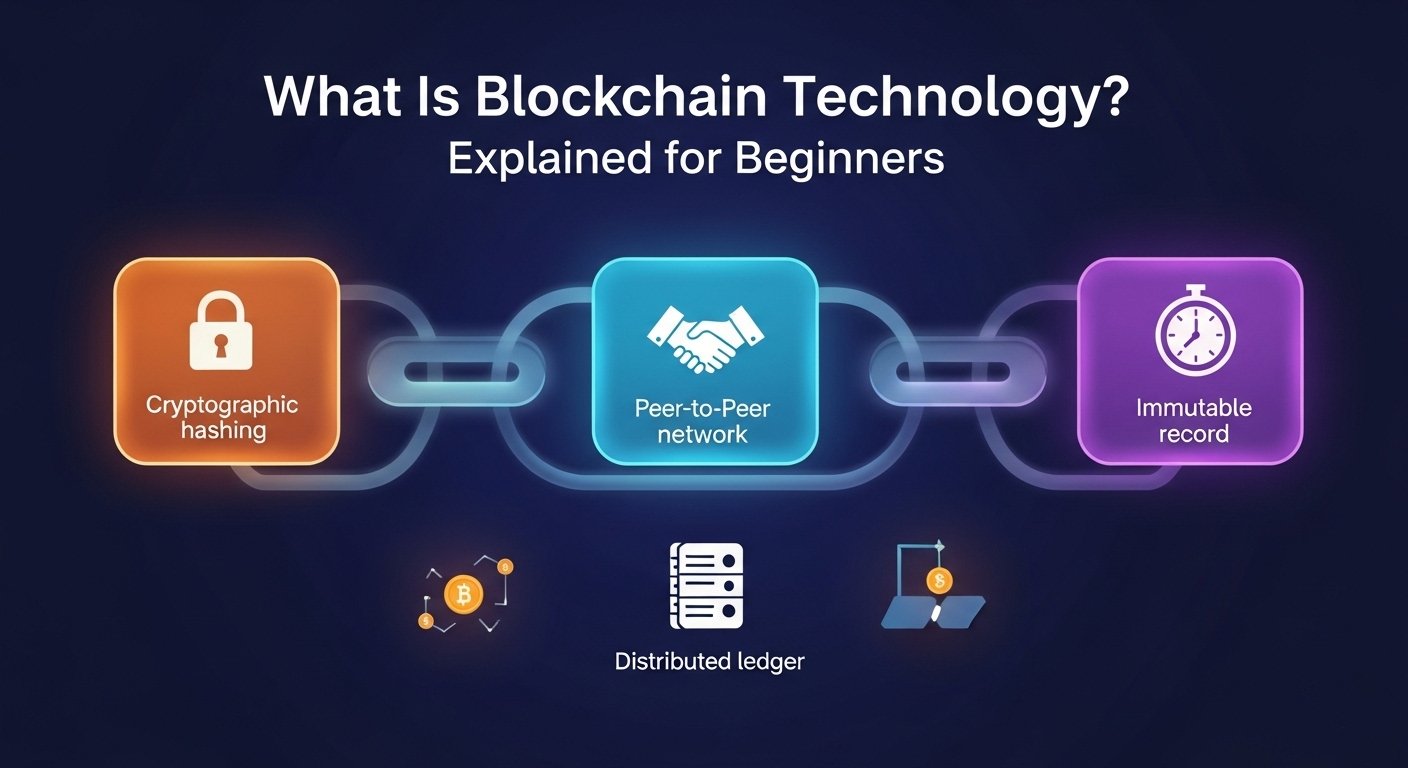
Blockchain is a distributed digital ledger that records transactions across many computers.
A ledger is simply a record of transactions. In traditional systems, banks keep their own ledgers. Blockchain works differently because the ledger is shared across a network of computers.
Each transaction is stored in a group called a block, and these blocks are connected together to form a chain. This is why the technology is called blockchain.
Every block contains:
- Transaction information
- Time and date of the transaction
- A unique digital signature called a hash
- A reference to the previous block
Because every block is connected to the previous one, changing one block would require changing all the blocks after it. This makes blockchain extremely secure.
How Blockchain Technology Works
Blockchain works through a network of computers that work together to verify transactions.
Here is a simplified explanation of the process.
Step 1: A Transaction Is Requested
A user initiates a transaction. For example, someone may send cryptocurrency to another person.
Step 2: The Transaction Is Broadcast to the Network
The transaction is sent to a network of computers called nodes.
These nodes verify whether the transaction is valid.
Step 3: Verification Process
The network confirms that the transaction is legitimate. This verification process may involve complex mathematical calculations.
Step 4: The Transaction Is Added to a Block
Once verified, the transaction is added to a block along with other transactions.
Step 5: The Block Is Added to the Blockchain
The new block is attached to the existing chain of blocks, creating a permanent record.
After this step, the transaction cannot easily be altered.
Key Features of Blockchain Technology
Blockchain has several unique features that make it different from traditional databases.
Decentralization
Traditional systems rely on a central authority such as banks or companies.
Blockchain operates on a decentralized network, meaning no single organization controls it.
Transparency
Transactions on public blockchains can be viewed by anyone. This transparency helps build trust in the system.
Security
Blockchain uses advanced cryptography to secure data. Once information is added to the blockchain, it becomes extremely difficult to modify.
Immutability
Immutability means that data stored on the blockchain cannot easily be changed.
This feature helps prevent fraud and data manipulation.
Why Blockchain Technology Is Important
Blockchain technology has the potential to transform many industries.
Here are some reasons why blockchain is important.
Improved Security
Blockchain protects data through encryption and decentralization.
Faster Transactions
Blockchain can process transactions faster than traditional financial systems in some cases.
Reduced Costs
Removing intermediaries such as banks can reduce transaction costs.
Greater Transparency
All transactions are recorded on a public ledger, which helps increase trust.
Real-World Uses of Blockchain Technology
Blockchain technology is used in many industries today.
Cryptocurrency
The most well-known use of blockchain is cryptocurrency. Digital currencies such as Bitcoin rely on blockchain to record transactions.
Supply Chain Management
Companies use blockchain to track products through the supply chain. This helps improve transparency and reduce fraud.
Healthcare
Blockchain can help store medical records securely and allow authorized users to access them safely.
Finance
Banks and financial institutions are exploring blockchain to improve payment systems and reduce fraud.
Digital Identity
Blockchain can help create secure digital identity systems that protect personal information.
Types of Blockchain
Not all blockchains are the same. There are several types of blockchain networks.
Public Blockchain
Public blockchains are open to everyone. Anyone can join the network and participate in transactions.
Example: Bitcoin
Private Blockchain
Private blockchains are controlled by specific organizations.
These networks restrict access and are used mainly by businesses.
Consortium Blockchain
Consortium blockchains are managed by a group of organizations instead of a single company.
Hybrid Blockchain
Hybrid blockchains combine features of both public and private blockchains.
Advantages of Blockchain Technology
Blockchain technology offers several benefits.
High security
Blockchain uses advanced encryption techniques.
Transparency
Transactions are recorded on a shared ledger.
Reduced fraud risk
The decentralized structure makes manipulation difficult.
Efficient record keeping
Blockchain provides a reliable way to store information.
Limitations of Blockchain Technology
Although blockchain offers many advantages, it also has some challenges.
Scalability issues
Some blockchain networks process transactions slowly during high demand.
Energy consumption
Certain blockchain systems require large amounts of energy.
Regulatory uncertainty
Governments are still developing rules for blockchain and cryptocurrencies.
Despite these challenges, blockchain technology continues to evolve.
The Future of Blockchain
Blockchain technology is still developing, but experts believe it will play a major role in the future of digital systems.
Many industries are investing in blockchain research and development.
Possible future uses include:
- Digital voting systems
- Smart contracts
- Secure data sharing
- Decentralized finance systems
As technology advances, blockchain may become an important part of global digital infrastructure.
People Also Ask
What is blockchain in simple words?
Blockchain is a digital system that records transactions securely across multiple computers.
Why is blockchain secure?
Blockchain is secure because it uses cryptography and stores data across many computers, making it difficult to change records.
Is blockchain only used for cryptocurrency?
No. Blockchain is used in many industries including healthcare, supply chains, and finance.
Who invented blockchain?
Blockchain technology was introduced with Bitcoin by an anonymous person or group known as Satoshi Nakamoto.
Can blockchain be hacked?
Blockchain networks are very secure, but other parts of the system such as exchanges or wallets may still be vulnerable if not properly protected.
Conclusion
Blockchain technology is one of the most important innovations in the digital world today.
By creating a secure, transparent, and decentralized system for recording data, blockchain has the potential to transform many industries.
Although it first became popular through cryptocurrency, blockchain is now being explored for many different applications.
For beginners interested in cryptocurrency and digital technology, understanding blockchain technology is an important first step.
As the technology continues to develop, blockchain may play a major role in shaping the future of digital finance and data security.


